
Cursive B
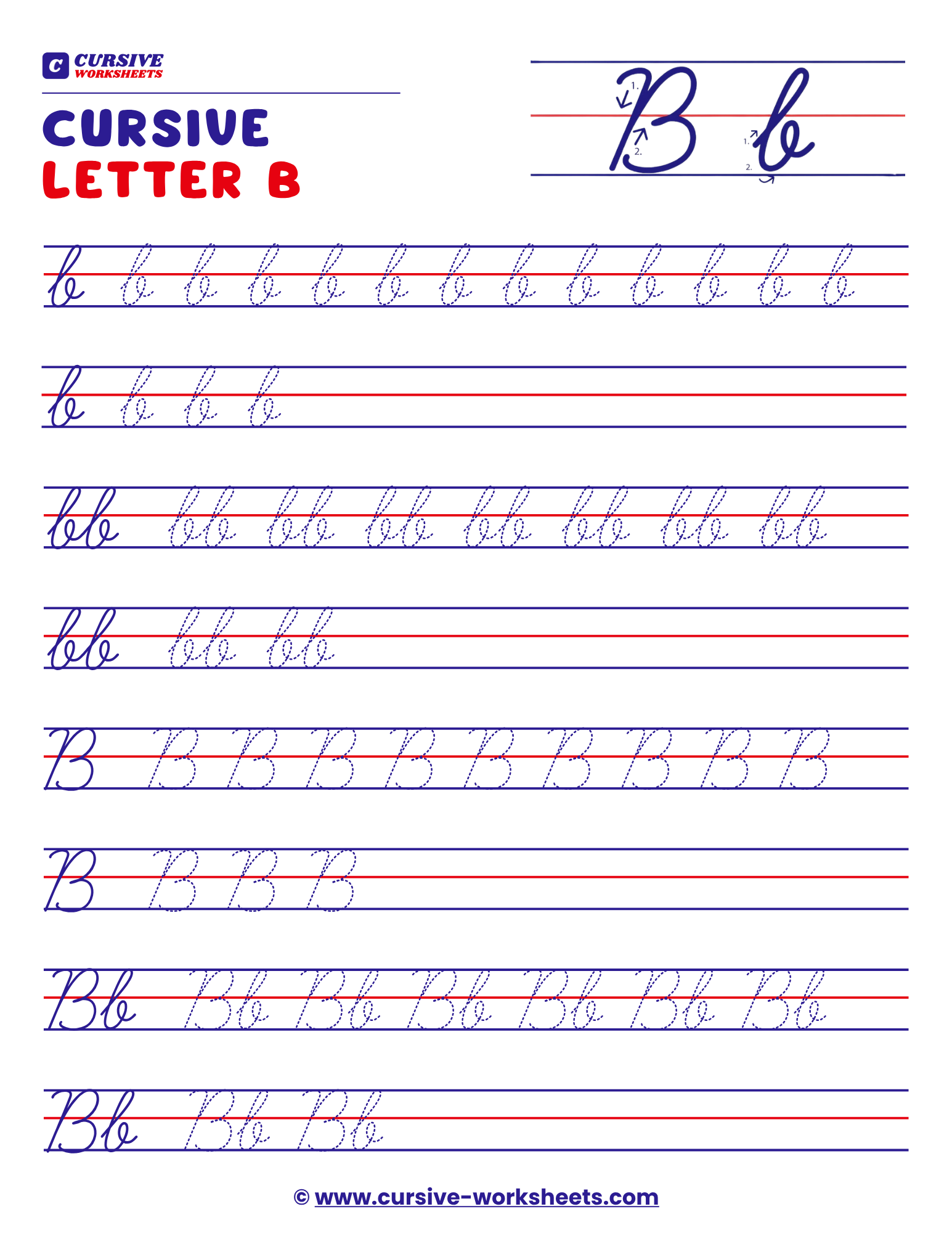
Practice uppercase cursive B and lowercase cursive b with free printable cursive B worksheets. Learn the basic strokes used to form each letter, practice the correct shape, and build smoother connections between b and other cursive letters.
Download Cursive B Worksheet
Download a free printable cursive B worksheet in PDF format to practice uppercase B and lowercase b. Use the tracing examples to learn the stroke sequence, then write the letters independently on the practice lines. Regular practice can help improve letter size, slant, spacing, and stroke control.
How to Write B in Cursive
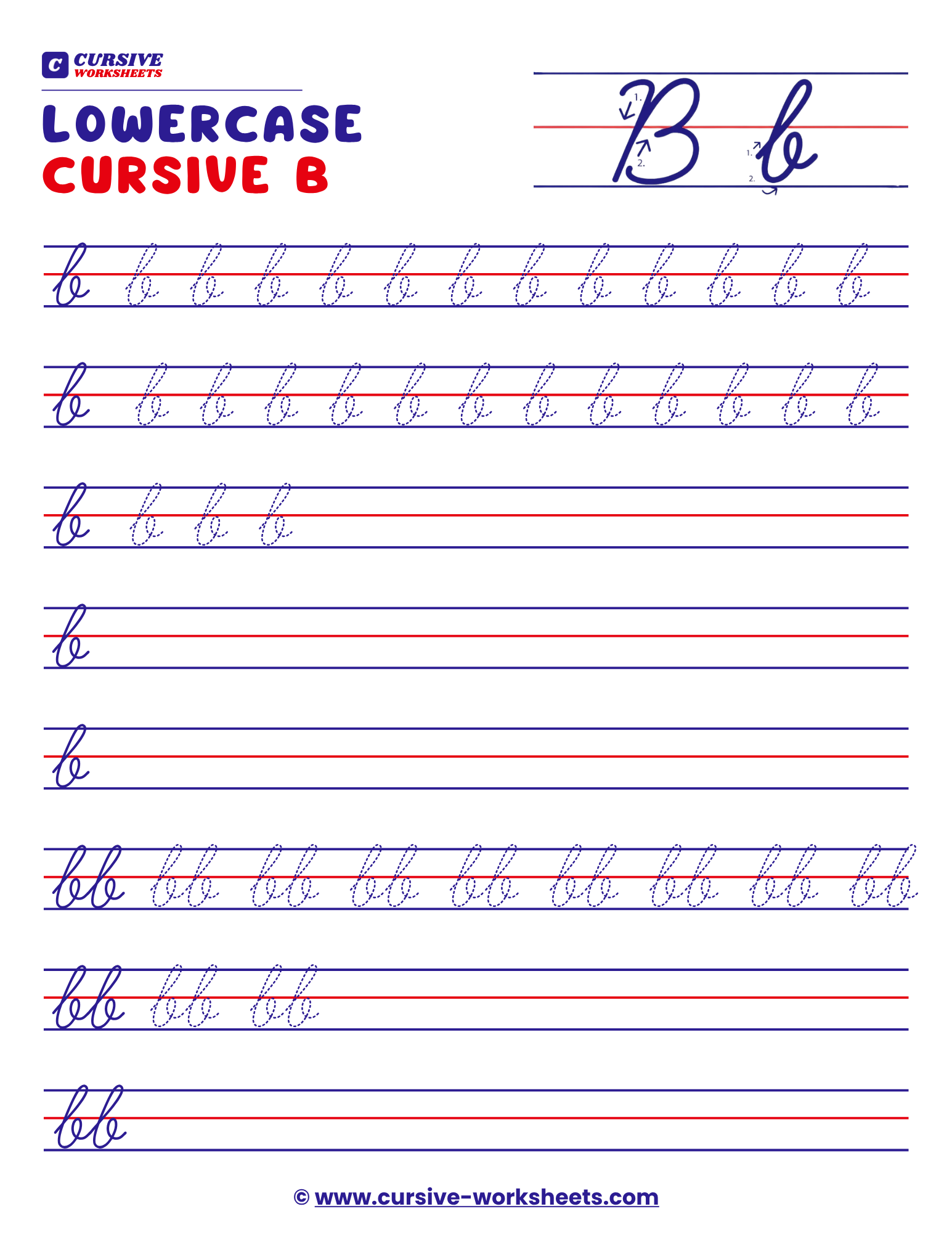
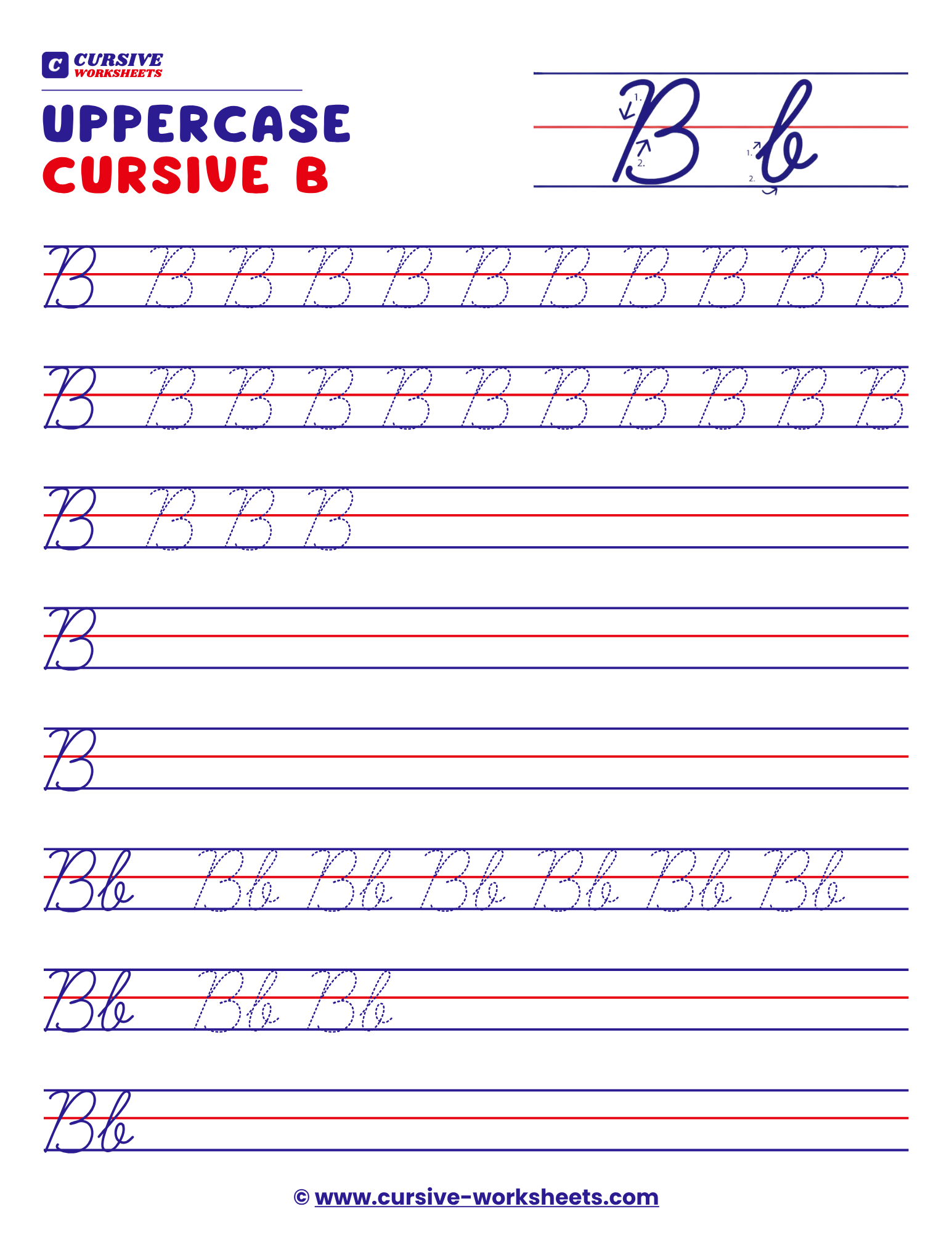
Cursive B has different uppercase and lowercase forms. Lowercase b begins with an entry stroke and rises into a tall loop before returning to the writing line. Uppercase B is larger and uses a tall main stroke with curved sections that form the body of the letter.
How to Write a Capital B in Cursive
To write a capital B in cursive, begin with an entry undercurve and move into the tall slanted portion of the letter. Retrace as needed, then form the rounded upper and lower curves that give the letter its distinctive B shape. Finish with a stroke that can lead toward the next letter when the style calls for a connected capital B.
Keep the two curved sections balanced and make the diagonal portion clearly taller than the lowercase letters that follow it. Practice the capital B on ruled paper and compare each letter for consistent height, width, and slant.
How to Write a Lowercase B in Cursive
To write a lowercase cursive b, begin with an undercurve that rises toward the midline. Continue upward into the tall loop, bring the stroke back down along the slant, and form the lower undercurve. Finish with a small checkstroke that can lead into the next letter.
A useful way to practice the Zaner-Bloser form is to remember its formation sequence: undercurve, loop back, slant, undercurve, then checkstroke.
The tall loop is an important part of lowercase b because it distinguishes the letter from shorter lowercase forms. Practice the loop slowly and keep it narrow enough to maintain a clear, consistent shape.
How to Connect Cursive B to Other Letters
The lowercase b has a finishing stroke that can flow into many following letters. Practice the letter by itself first, then add simple two-letter combinations before moving to complete words.
Connecting Lowercase Cursive B
After forming the rounded body of the lowercase cursive b, finish with its exit stroke toward the right. This stroke can connect directly to the next lowercase letter. Practice common combinations such as ba, be, bi, bl, bo, br, and bu.
When practicing, focus on keeping the tall stem consistent with the height of other ascender letters and maintaining a steady slant. Start with two-letter combinations before moving on to complete words such as bat, bed, big, blue, and bring.
Connecting Uppercase Cursive B
A capital cursive B can connect to a following lowercase letter through its finishing stroke in some cursive styles. The exact connection can vary depending on the style of cursive handwriting being practiced. Practice the capital B slowly before adding another letter.
Try combinations such as Ba, Be, Bi, Bl, and Br. Repeating these combinations helps you understand how the uppercase cursive B flows into lowercase letters and makes connected handwriting feel more natural.
The key is to follow the same letter shape and connection pattern each time. Use a cursive B worksheet to trace the letter first, then practice connecting it to different letters without tracing.
Common Mistakes to Avoid When Writing Cursive B
When practicing cursive B, focus on the details that make the letter recognizable and easy to connect. The most common mistakes happen with the tall stem, loops, curves, spacing, and finishing stroke.
- Making the lowercase b too short: The stem of lowercase b should rise to the upper writing line. If it stays within the lowercase writing space, the letter can look more like another lowercase letter.
- Making the tall loop too wide: Keep the upper part of lowercase b narrow and controlled. A loop that is too wide can make the letter look uneven or difficult to recognize.
- Making the lower curve too large: The rounded part of lowercase b should stay proportional to the tall stem. An oversized curve can make the letter look unbalanced.
- Using a printed-style capital B: A cursive capital B uses flowing strokes and curves rather than simply copying the block-style B used in print. Follow the cursive form you are practicing.
- Making the capital B too small: The uppercase B should be noticeably taller than lowercase b. Keep it aligned with the upper writing line and make sure its main curves have enough space.
- Adding too many strokes: Try to form the B with smooth, controlled movements instead of repeatedly lifting the pencil or adding unnecessary lines.
- Forgetting the exit stroke: The final stroke of lowercase b should lead naturally toward the next letter. A short or awkward tail can make connected writing harder.
- Changing the slant between letters: Keep the cursive B at a similar angle to the other letters in your handwriting. A sudden change in slant can make the B look disconnected.
Practicing with the Printable Cursive B Worksheet
Use the printable cursive B worksheets to practice the tall loop and curved movements that make B recognizable. Start with tracing exercises so you can follow the stroke direction and observe how the letter fits between the writing guidelines.
After tracing, practice lowercase b independently. Work through short combinations such as ba, be, bi, bo, bu, bl, and br before writing complete words. Words such as baby, blue, boat, brush, and bright provide different connection patterns for additional practice.
For uppercase B, begin with individual letters and then practice selected combinations such as Ba, Be, Bl, and Br. If your cursive model uses an unjoined capital B, practice placing the capital naturally at the beginning of a word instead.
Move from slow, careful writing to more fluent practice once the letter shape becomes consistent. The goal is not simply to write B quickly but to maintain a clear form while moving smoothly from one letter to the next.
Frequently Asked Questions
Cursive B has separate uppercase and lowercase forms. A capital B uses a tall main stroke with curved sections, while lowercase b begins with an undercurve and rises into a tall loop before returning to the writing line. The exact appearance can vary between cursive styles.
Begin the lowercase b with an undercurve, rise into the tall loop, return down along the slant, and finish with the lower undercurve and connecting checkstroke. This sequence follows the lowercase b formation used in the Zaner-Bloser model.
A lowercase cursive b typically has a tall loop that rises above the midline, followed by a rounded lower portion and an exit stroke. Its tall loop helps distinguish it from shorter lowercase letters.
Start with the entry stroke and the tall main portion of the capital B, then form the curved upper and lower sections before finishing the letter. Keep the letter tall, controlled, and consistently slanted. The exact stroke sequence and connection can differ between handwriting systems.
It depends on the cursive style. Some handwriting systems teach capital B as a connected letter, while others allow or teach it as unjoined. Zaner-Bloser, for example, presents both joined and unjoined forms of Ba in its instructional material.
Lowercase b can be practiced with many following letters. Useful combinations include ba, be, bi, bl, bo, br, and bu. These combinations help learners practice both vowel and consonant connections.
The most common reasons are an unclear tall loop, an overly wide loop, or an incorrect starting stroke. Practice the loop and undercurve separately before combining the movements into the complete lowercase b.
Try words such as baby, bed, bite, blue, boat, brush, bright, and bubble. These words let you practice lowercase b at the beginning of words and in different connection patterns.
Start with the basic strokes and a clear letter model. Have the child trace several examples, reproduce the letter without tracing, and then practice short combinations and familiar B words. Once the letter becomes consistent, introduce sentences for more natural handwriting practice. Structured progression from a model to independent reproduction is also recommended in systematic handwriting instruction.
Lowercase b is a tall or ascender letter, so its main stroke extends above the midline used by shorter lowercase letters. This height difference is part of what gives b its recognizable shape in cursive writing.