
Cursive F
Practice uppercase cursive F and lowercase cursive f with free printable cursive F worksheets. Follow simple writing steps, learn proper letter formation, and improve cursive handwriting through guided practice.
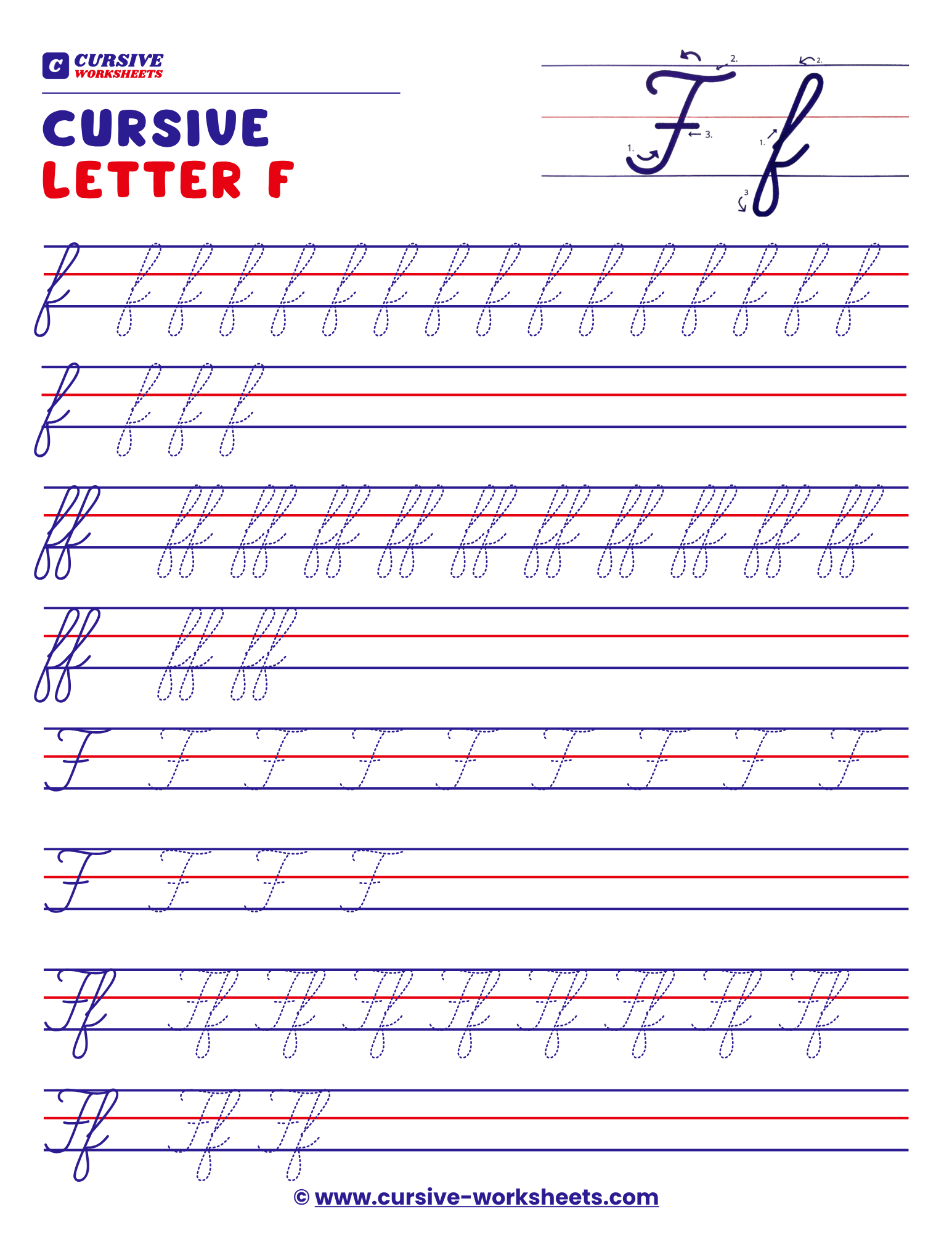
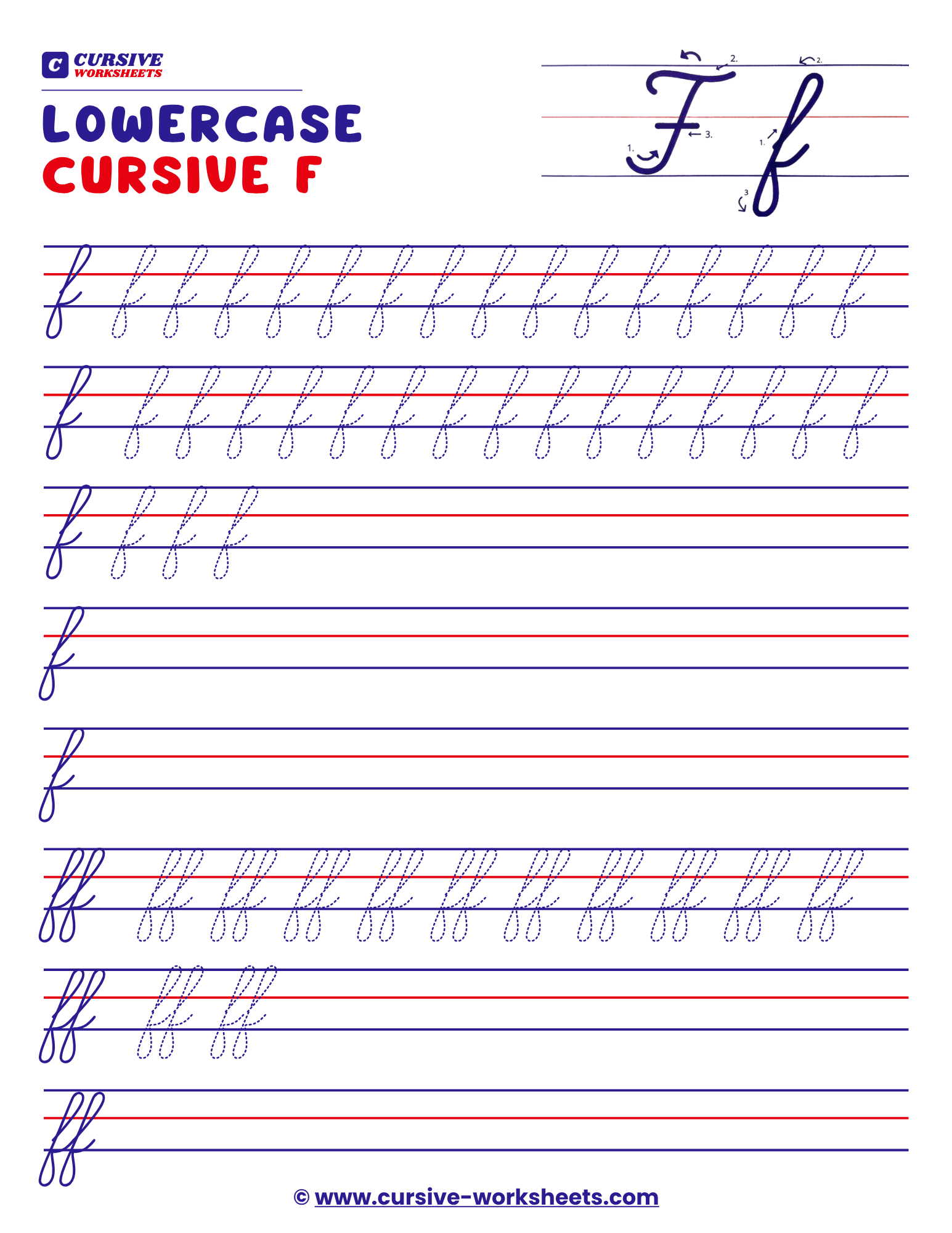
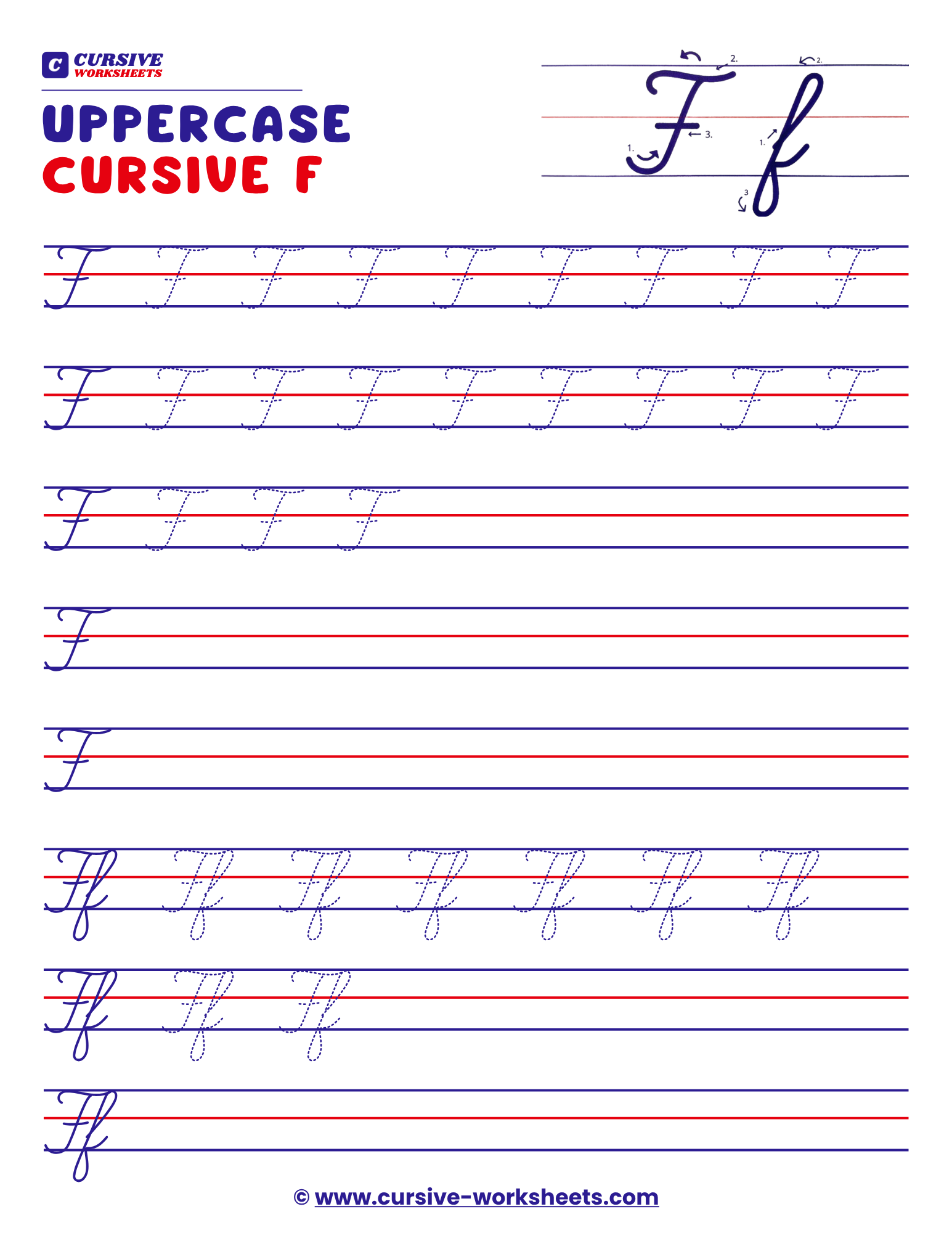
How to Write F in Cursive
Writing F in cursive becomes easier when you practice each stroke in the correct order. The uppercase cursive F and lowercase cursive f have different shapes, but both use smooth, flowing strokes. Lowercase cursive f is different from many other lowercase letters because its main stroke can extend both above and below the baseline. Start slowly, follow the writing lines, and focus on keeping your letter size and slant consistent.
How to Write a Capital F in Cursive
Capital cursive F can look different depending on the handwriting style being taught. Start with the model shown on your worksheet and pay attention to the direction of the main stroke, the upper curve, and the finishing stroke.
A good capital F should have a clear upper section and enough space between its strokes. Keep the letter tall without making it overly wide. Finish with a controlled exit stroke if the following letter is meant to connect.
How to Write a Lowercase f in Cursive
Lowercase cursive f has a distinctive tall loop and a lower stroke that extends below the baseline. In the Zaner-Bloser model, the letter begins with an undercurve, loops back, slants, and loops forward, followed by an undercurve. Their practice materials also emphasize making the first undercurve deep enough to keep the loop open. To practice the lowercase f:
- Begin with a deep undercurve.
- Bring the stroke upward and loop back.
- Slant the stroke downward through the tall part of the letter.
- Continue into the forward loop.
- Finish with the lower undercurve.
How to Connect Cursive F to Other Letters
Connecting Lowercase Cursive f
Lowercase f can connect with many letters in words. Common combinations include: fa, fe, fi, fl, fo, fr, fu, fy. Useful practice words include: face, feel, fine, flag, flower, fresh, funny.
Zaner-Bloser practice materials specifically include combinations such as fe, fl, fr, fa, fo, and fy, along with words such as falcon and identify.
When practicing these joins, pay close attention to the point where f leaves one part of the letter and moves into the next. The long shape of f can make the connection look crowded if the letters are written too close together.
Connecting Uppercase Cursive F
Uppercase F is often taught as a standalone capital, but some cursive styles allow it to flow directly into the next lowercase letter. Examples include: Fa, Fe, Fi, Fl, Fr.
Words such as family, famous, field, flower, and friend can provide useful practice. Not every cursive system uses the same capital-letter connections. If the worksheet model keeps capital F separate, focus on making the letter clear and well spaced rather than forcing a connection.
Common Mistakes to Avoid When Writing Cursive F
Lowercase e is a small letter, so minor changes in its loop, height, or ending stroke can affect how clearly it reads. Focus on these E-specific details during practice.
- Making lowercase f too short: Lowercase f needs a tall stroke. If it stays around the midline like a short letter, it can lose its characteristic shape.
- Closing the upper loop too tightly: A narrow loop can make f difficult to recognize. Keep enough space inside the loop for a clear opening.
- Making the first undercurve too shallow: The opening movement helps create the loop. A shallow start can cause the upper loop to collapse.
- Forgetting the lower extension: In cursive styles where f extends below the baseline, stopping the stroke early changes the letter's proportions.
- Making the lower loop too large: The descending portion should remain controlled. An oversized lower loop can make the letter look messy or take up too much space.
- Writing a printed-style capital F: A block-style F does not have the flowing movement expected in cursive. Follow the capital model used in your worksheet.
- Changing the slant halfway through the letter: Because f travels through a long vertical space, changes in direction can become very noticeable.
- Connecting the next letter too quickly: Rushing the exit stroke can make the following letter overlap the tall or lower part of f.
Practicing with the Printable Cursive F Worksheet
Start by tracing several lowercase f letters so you can feel the long movement of the stroke. Next, write f without tracing and check whether the loop stays open and the lower stroke reaches the correct writing zone.
After practicing the single letter, move to short combinations such as fa, fe, fi, fl, and fr. Then write familiar words such as face, family, flower, friend, and funny.
Capital F can be practiced separately before combining it with lowercase letters. Teachers and parents can ask children to compare their letters with the model and check three things: the height of f, the shape of its loops, and the spacing around the next letter.
Frequently Asked Questions
In the Zaner-Bloser model, lowercase f begins with an undercurve, moves into a loop, slants downward, forms a forward loop, and finishes with an undercurve. The letter is tall, and its lower stroke extends below the baseline.
Cursive f uses more vertical space than many lowercase letters. In the Zaner-Bloser classification, f is a tall letter and can also extend below the baseline, which makes its formation more complex than short letters such as a, c, e, or o.
The loop is an important part of lowercase f, but it should remain open and balanced. If the first undercurve is too shallow or the loop is pulled too tightly, the letter can become difficult to read. Zaner-Bloser specifically recommends making the first undercurve deep enough to keep the loop open.
In cursive styles that use the traditional descending form of f, the lower stroke extends below the baseline. Zaner-Bloser identifies f among the cursive letters that can reach the next headline below the baseline.
Lowercase f can connect with many letters, including a, e, i, l, o, r, u, and y. Common combinations include fa, fe, fi, fl, fo, fr, fu, and fy.
Good practice words include face, feel, fine, flag, flower, fresh, funny, family, and friend. Start with shorter words before moving to longer words that contain several joins.
Write the lowercase f using the letter model first, then continue its exit stroke into the tall beginning of l. Practice fl slowly before writing words such as flag, flower, and flight.
The long loop and lower movement can make f spread across the writing space. Keep the loops narrow enough to stay within the intended guidelines, and avoid pulling the lower curve too far to either side.
That depends on the cursive style being taught. Some handwriting systems connect certain capital letters to lowercase letters, while others keep them separate. Follow the capital F model on your worksheet instead of forcing a connection.
Begin with tracing, then move to independent lowercase f writing. Once the letter is comfortable, practice fa, fe, fi, fl, and fr, followed by familiar words. Short practice sessions with careful attention to the loop and lower stroke are more useful than rushing through many lines.